Tuesday, February 18, 2014

Rewind: Lunch Invivation at a Floating Village (Nov 16, 2013)

(日本語はこちら)

The population of “floating villages” is officially unknown although some studies shows about 5-10% of the entire Cambodian population live on or around the Tonle Sap lake. It’s a fascinating lifestyle. There are mobile houses, chicken coops, crops (people grow water vegetables), schools, churches, and stores all sprawled across different areas in the lake. There are multiple communities that live around the lake and in recent years visiting these villages have become a sort of lucrative tourist business. I do understand i's a good source of income for the community but it always seemed a bit weird to me to go on a “tour” of a village like it’s some sort of safari attraction.

Luckily I was blessed that one of the volunteer teachers’ student, Leak was living on these communes and invited him over for lunch. Even though I had just met her that day, she generously invited me over as well. Leak’s commune is smaller than the usual ones advertised for tours and is about a 20 min motorbike ride away from Siem Reap’s city center. 


Now just need to get the other side..

Leak came to pick us up on her boa 

Colorful houses


The mom taking some guests back to land


 Many often associate floating villages with poverty but what I saw was quite different. Also many often think that the villagers were forced into living in these inconvenient life styles. This notion is wrong as well.

Many of the floating village houses have electricity, either through by electric cables that have been connected through land or are generator operated.


Floating village houses are usually either floating and tied to an anchor or the building itself is built over water. Leak’s house was the latter in which the house stood over a concrete manmade island. The bottom of the house was used as a "garage" for the boats as well as a chicken coop and a small garden. The inside of her house was spacious with loosely divided areas for living room/eating space, bed room, and kitchen/bath. They even had two TVs, two sewing machines, and their own well. 

You can see straight down to the water between the boards..pretty scary! But it's sturdy.


"Bedroom" area


"Kitchen" area. It's spick and span! 


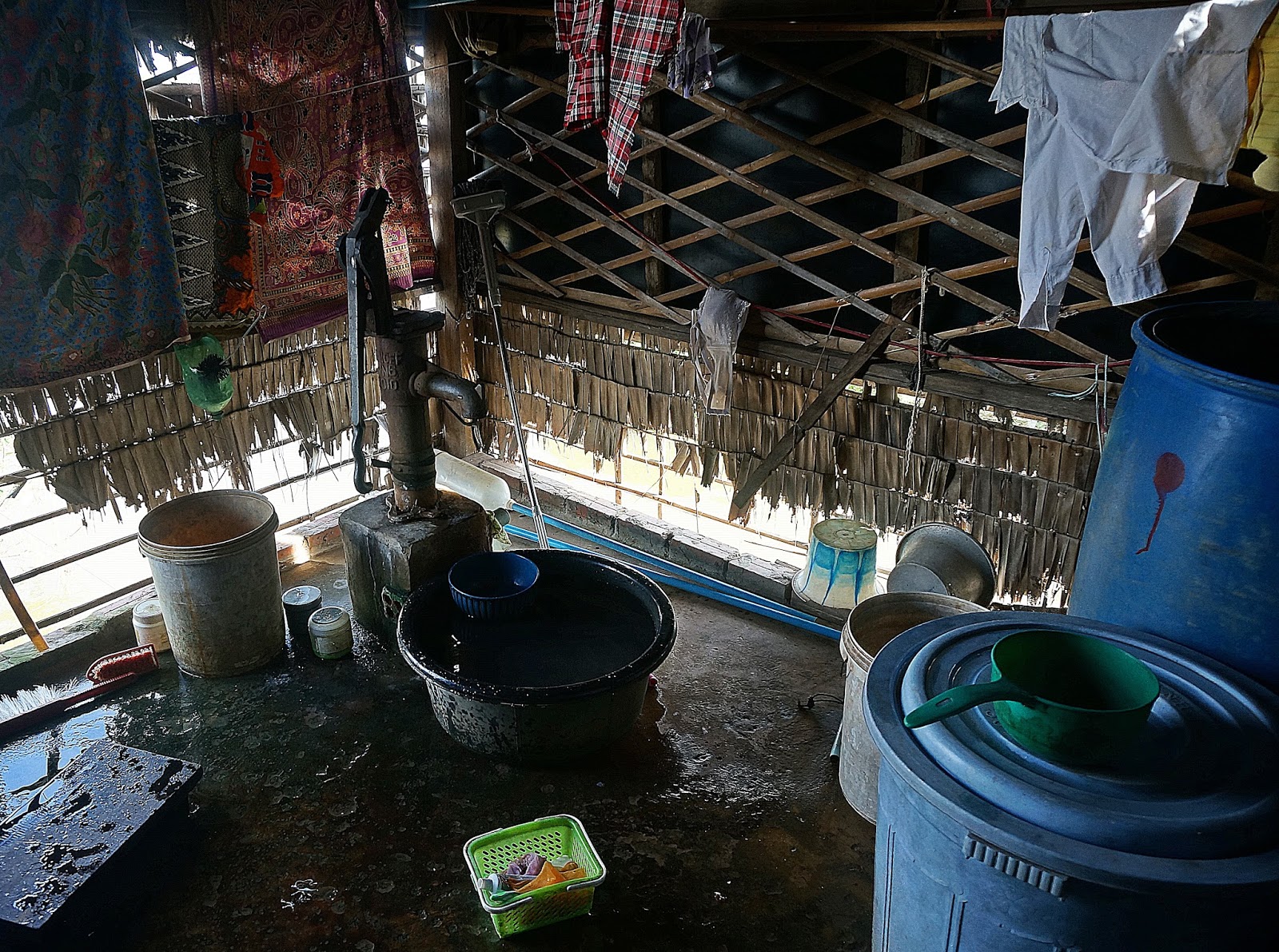
"Water" area. They even have their own well


The dad was into watching some kind of Khmer talk show. It was cute

The lunch was traditional Khmer style which was delectable. Most of the food came straight from the water including the fish and water vegetables grown on the lake. Chili and a few other vegetables were made from their small vegetable gardens inside or outside the house. 


homegrown chili


fishing net

freshly caught water crabs


What is surprising is that many of the villagers don’t know how to swim. Some communes require children to swim as a prerequisite to enter school (in terms of safety since they all have to ride a boat to get to school) but since Leak’s commune is near the shore, there isn’t as a big danger.


Hello neighbors!


Thank you for being such wonderful hosts :)


Taking a "cruise" around the "neighborhoods"


Water grass. It's edible (we had it for lunch)
Steer from the other parked boats!


I asked another student who grew up on a floating village what it was like compared to living on land. Presumably, I thought living on land was a better lifestyle for him. But to my surprise he said that he missed it. He said he used to jump from house to house going over to a friend’s house. When they were bored, the lake was their biggest playground. Moreover, food was abundant and the community was very close knit. It may not be the most extravagant life style but he said he definitely felt at home there. 


Rewind: Water Festival (Nov, 2013)


In a previous post, I mentioned that not much activity has been going on for Water Festival due to some issues that they’ve had in the past. It turns out, there were boat races were held by the Tonle Sap River which attracted many locals in the area. Apparently it wasn't advertised too widely to avoid the large crowds. The good thing was that we were one of the only foreigners so it was good to see the festivities without any interference of other tourists which was nice. 


湖の上の家

Note: this is the exact same post as my other post in English. I wrote this in Japanese so my little cousins can read and learn from it ;)

雨季の時期になると東南アジア最大を誇る湖、トンレサップ湖。その周りには全カンボジア人口の5-10%が住んでいるとか。湖の周りだけではなくて湖の上に住む人々、いわゆる水上村も数多く存在します。最近では観光業界も注目していて観光客用の水上村のツアーもいろいろあるんだけどなんだか人の毎日の生活を邪魔しているようでなんとなくツアーには参加できないでいたんだよね 汗

たまたま今回お邪魔したのはあたしが働いているNGOが経営している英語学校の生徒、リアックちゃんの自宅。シェムリアップからバイクで20分ぐらいなので毎日通学しているそう。

水上村に住んでいる人たちは貧乏、っていうイメージが強いけどリアックちゃんが住む村は比較的裕福ななのか、生活水準が予想以上に高くてびっくり。

ここから向こう岸まではボートで行きます♪
リアックちゃんがマイ・ボートでお迎え
 

水上村

家は15畳ほど。風通しが良くて気持ちいいです☆


水上村は本来電気も水も通っていないのですが、この村ではちゃんと電気がありました。水道はないものの、各家庭に井戸があるようです。家自体は水の上に浮いているというよりは高床式になっていて、家の下にはちょっとした土台があってそこにボート置き場と鶏を放し飼いしていて効率的。

板の間から湖が見えるので歩くたびヒヤヒヤ 汗
寝室エリア。ハンモック気持ちよさそう☆

キッチンエリア。きっちり綺麗にしています。

水周りエリア。各家庭に井戸があるのは驚き

お父さんはテレビでローカルのバラエティ番組を見ていました 笑


そしてランチもご馳走していただきました♪ 食べ物はほとんどが採れたて・獲れたてなのでこれがまた新鮮でおいしかった~ (*^^*)


カンボジア料理はベトナム料理とタイ料理に押され気味で世界からあまり注目されていないのが残念なのだけど、あたしは大好きです。ベトナム料理ほどハーブが強くなくて、タイ料理ほど辛くないので日本人の口にもかなり合うはず。最近の調査ではカンボジア料理が世界一健康的と称されたほどなので今後はもっと人気が出てくれることを願います☆

カンボジアでもゴーヤチャンプルがっっ!なんとなく親近感が♪


プランターでは唐辛子を育ててます

魚を釣る網


獲れたてのカニ

食後はみんなでボートで近所を探索しながらちょっぴり昼寝 笑。カンボジアは時間が本当にゆっくり流れるんだけど水上村はまるで時間が止まっているようでなんとも至福のひと時でした


近所のご家族です。買い物帰りかな?

リアックちゃんのご両親。お世話になりました~


水草。実はこれ食べられるんですよ。↑のランチにも出されています。見つけられるかな?
狭い場所を漕ぐのも慣れればお手の物
水上村での生活は貧乏で大変と聞かされていたのですが、今回の訪問でよくよく考えさせられました。確かに途上国に比べれば貧乏な生活なのかもしれないけど、決してそれが大変だとか不幸という印象は受けられなくて逆に獲れたての魚と野菜が食べられて少し羨ましいなと思ったぐらい。そしてなんといっても家族全員が穏やかで始終笑顔を絶やさなかったことがすごーく印象的でした。貧乏=不幸せと結びつけるのはどうなのかなとつくづく考えさせられました。

英語学校では他に数名水上村出身の生徒がいるのですが、村での生活を聞いてみると不便で貧乏というよりは「懐かしい」と答える生徒が圧倒的でした。村では時間があれば友達と水に潜って魚を捕まえたり、家から家へジャンプして遊んだりと人との繋がりがすごく強いんです。そういう意味ではシェムリアップのような都会は少し心細いという面もあるのかな。

人にとって何が幸せなのかいろいろ考えさせられました。

Sunday, February 16, 2014

Cambodian Cultural Village

It started out as a mere suggestion as a weekend visit from one of the long time volunteers. Then it turned in to an LHA outing. And then the monks were galvanized to come along.

The Cambodian Cultural Village had been a popular attraction site in Siem Reap, attracting locals and tourists. However, a little bit of research revealed that reviews for this place were abysmal.  Nevertheless, the monks insisted on going so a couple of volunteers agreed tag along (I mean who can say to the monks?). Upon arriving, I understood why. It’s free for monks and hugely popular among middle-class locals as it showcases eclectic aspects of Cambodian culture. For locals its $5, which is not cheap (most tourist attractions are free ~ $2 for locals). For tourists it’s $15.

This amusement park is on National Road 6 on the way to the airport and you cannot miss it because it is huge. It has several sections which features different ethnic tribes, a wax museum, and various stages that hosts shows throughout the day.  

To all the negative reviewers on TripAdvisor and those who are contemplating whether to go or not, I offer the following advice to you before going:  

1.    Go on the weekends because that’s when all the shows happen

Since the shows start around 2:30pm, I especially recommend going around 1~1:30pm to take hour exploring the wax museum and walking around the venue. There are many serene parks and a replica of the Tonle Sap Lake which is quite nice. Interestingly, there also exists as a “Khmer American Village” depicting an American suburb where many of the refugees were sponsored. It’s quite funny because Cambodian enclaves in California are in Oakland or Long Beach which look nothing like this. Oh well.


My best guess, is it's from Smallville..?


There reviews for the shows are mixed. but I loved it. The performers were jocular and the dancers moved about deftly. Remember, the shows are catered towards locals and their humor so just sit back and laugh along with them. And FYI, I thought they were quite funny.

Peacock Dance at the Kola Village

Chinese lion dance & clowns at the Chinese Village
Bride selecting ritual show at the Kreung Village


2.    Pick which shows you want to go beforehand

The shows happen one after the other with 10 minute breaks in between so many rush from theater to theater. Obviously this creates a big mess when trying to get seats. Instead of being greedy, choose about 3 or 4 shows you really want to watch and get to the theater early to secure yourself a seat.

Theaters get packed!


3.    If possible, go with a local. 
One thing that was disappointing was that the museum did not have many descriptions about the displays. To Cambodians, most are displays and wax figures are distinguishable but not to the tourists who are unfamiliar with them. Luckily the monks gave us an explanation which helped us immensely to understand the historical and cultural context. Moreover it was nice to see that the locals were full with pride looking at their historical accomplishments and achievements.


4.    If you want to save on money, look Cambodian.
$15 entrance fee is hefty considering a one-day entrance pass to Angkor Wat, a UNESCO World Heritage site, costs $5 more. 

However with my Asian look and local fashion style (leggings, cap, long-sleeve, mask, flip-flops) caused a bit of stir at the ticket counter. They asked me if I was Cambodian in Cambodian in which for a split second my inner bad side abetted to making me answering yes (and saving $10). But having just repent my sins on Meak Bochea day, I answered "I wasn’t". I replied back in Cambodian in which made them even more confused. Even the guy checking the tickets asked where I was from (I answered “mao bpii prok tei amerique” – I am from the US to which he rolled his eyes). It’s interesting I’m slowly blending in with the locals here. So, lesson of the story is look like and speak like a Cambodian. I’M JUST JOKING! PLEASE do NOT do this as the fee contributes to maintaining the park and also supporting the workers and performers

Besties :)

STOP PULLING MY EAR!


Beautiful Kreung Tribe costumes